Our Fences > Frequently Asked Questions:
Be An Educated Consumer
Please
read through our frequently asked questions section to help clarify
some myths about mesh pool fencing.
1.
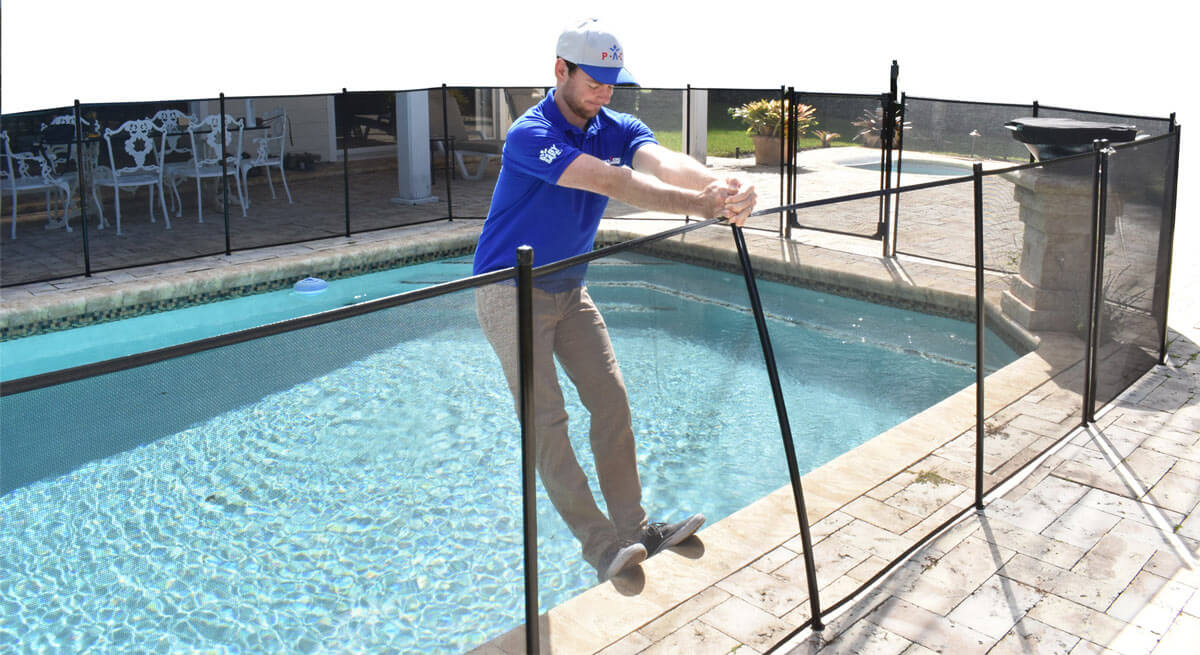
CAN MY CHILD KNOCK THE FENCE OVER?
Protect-A-Child Pool Fencing has been helping prevent children
of non-swimming age from reaching their home swimming pool for
over 25 years. During that time it has become one of the most
effective pool safety devices for one reason. It is sufficiently
strong to do an effective job of preventing children under age
4 from reaching the pool. (See our “DROWNING
PREVENTION PAGE”) While we don’t want to foster
any false sense of security that might lead you to believe you
can leave your child unsupervised at any time, Protect-A-Child
Pool Fencing can help bridge the gap left by momentary lapses
of supervision. Our promotional video includes footage of children
running into our fence. Contact
us to receive a copy of this video that should put your mind
at ease.
2.
CAN MY CHILD CLIMB THE FENCE?
The mesh surface of Protect-A-Child Pool Fencing will not allow finger
or toe holds thus making our fence one of the least climbable fences
available. However, parents must continue to supervise their children
because you never know if they might try and pull a chair up to the
fence to gain a height advantage.
3.
CAN MY CHILD LIFT THE POSTS OUT OF THE HOLES?
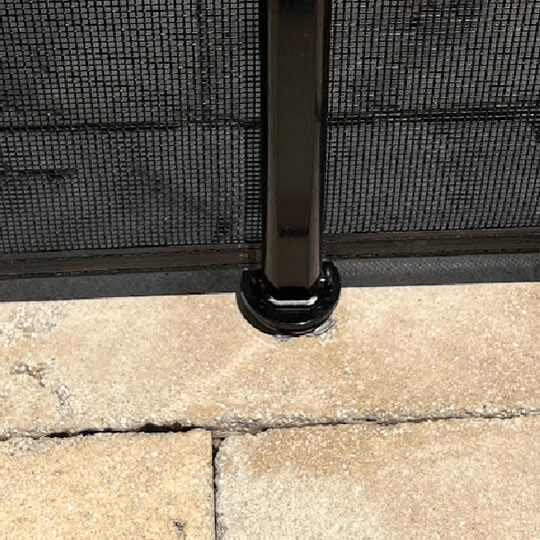
Proper installation of the fence provides a “tension fit”
that prevents most children from lifting the fence out. However, this
tension fit does not mechanically hold the fence into the patio. For
complete peace of mind we suggest our Lock-in-deck
feature that actually twist locks the fence posts into the patio and
prevents their removal by children.
4.
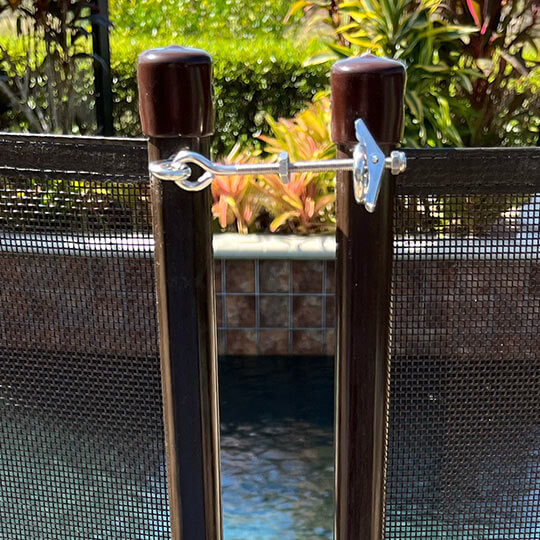
CAN MY CHILD UNLATCH THE SECTIONS?
You will notice in the description of our patented Point
Lock Secure Latch that these latches were invented to improve safety
by preventing children from unlatching the simple safety gate hook latches
found on most mesh fences. The Point Lock Latch, with it’s patented
double locking mechanism, is the safest section latch available for
children. It dramatically increases safety by preventing a child from
unlatching the sections.
5.
HOW SHOULD I CLEAN MY FENCE?
Black mesh fences are very transparent and rarely show dirt which explains
their popularity. However if you have a lighter color fence or just
wish to clean your fence, soap and water with a sponge, rag, or scrub
brush work fine.
6.
I REMOVED MY FENCE WITH NO PROBLEM. HOW DO I KNOW HOW TO REINSTALL
IT?
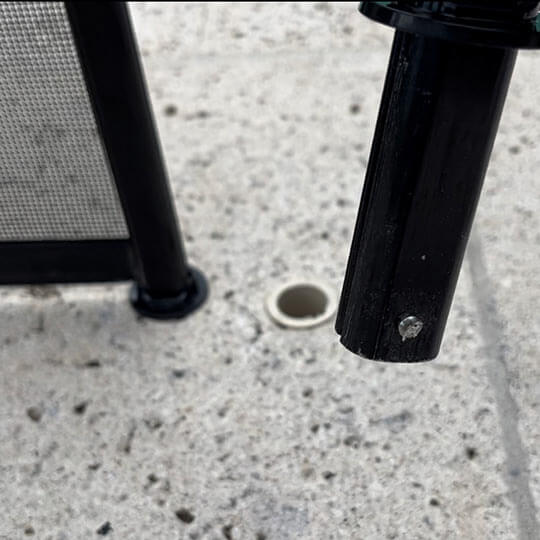
Note the pattern of small holes in your patio. In places you will
see two holes together approximately 2” apart. These designate
(sections begin and end
) a section begins and ends so that
the two sections can latch together. Start a section there placing
the molding side of the fence opposite the pool. Note that while
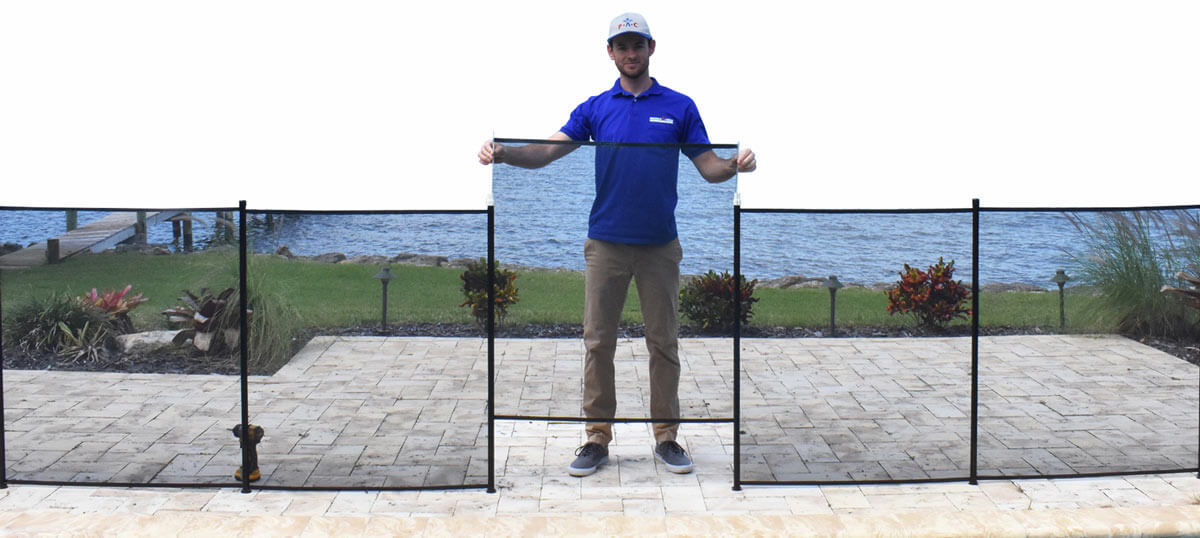
the majority of sections are 12’ in length (10’ in
the 5’ height) your fence may have some 9’, 6’,
or a custom length section tailored on one end. Noting the position
of the customized section and the number of posts in it will help
you ascertain its’ position.
What
about Protect-A-Child's Quad Bilt fiberglass posts and patented safety
features?
1.
A COMPETITOR SAID THAT YOUR FIBERGLASS POSTS WILL DETERIORATE IN THE
SUN AND CRACK ALL BY THEMSELVES. IS THIS TRUE?
Parents
should know that many competitors who offer only aluminum support posts
find their best tactic to sell their fencing when faced with competition
from our Quad Bilt composite posts is to disparage the performance of
fiberglass support posts. Using common sense to consider examples of
fiberglass products and their performance over the past 50 years makes
it easy to see the truth. In both building products and the marine industry,
the characteristics of fiberglass products have been well proven in
terms of strength, weather resistance, and longevity. Consider that
nearly all boats are fiberglass. They don’t deteriorate in the
sun, crack, and then ultimately sink as these sales people are suggesting.
In the building trade, the highest quality, hard working tools such
as hammer, ax and pick handles, as well as fiberglass ladders are all
made from fiberglass and recognized as the best available. Protect-A-Child's
Quad Bilt posts are not inexpensive, imitation fiberglass composite
posts. They are manufactured with
a proprietary 4 step process providing significant strength and longevity.
The last of these processes is sheathing with a
polyester veil which prevents UV breakdown and the exposure of fiberglass
rovings. The process used to construct Quad Bilt posts has been tested
and certified to 30 years against UV degradation and in pressures exceeding
15,000 lbs. When you stop and consider the superiority of composite
fiberglass materials in the applications mentioned above, we are confident
you will realize the truth.
2.
THE SAME COMPETITOR SAID WE WOULD BE EXPOSED TO FIBERGLASS SPLINTERS
IF THE POSTS BREAK.
We are
constantly amazed at the creativity of some salespeople. First
of all, let's face it, broken is broken no matter what the post
and must be repaired. However, even when broken, Quad Bilt posts
still offer superior safety to aluminum posts. First of all, with
Protect-A-Child’s Quad Bilt fiberglass posts, they are stronger
and have the ability to flex with shock thus avoiding most breakage
scenarios all together. But certainly it is possible for one to
break if forced past its strength threshold. In this case the
fiberglass posts do not crack off nor do they sever from the patio
as is the case with aluminum posts. They merely crack along a
short length of the post right above the patio yet remain wholly
in one piece and continue to anchor the fence to the patio surface.
This keeps the fence in place and continues to provide an element
of safety until the post can be replaced.
...being edited....
Because
the post is still fully attached to the fence, a child cannot
reach any part of the cracked post since it remains fully shielded
behind the mesh surface.
Now lets
compare that with the performance of aluminum posts when stressed to
the breaking point:
When an
aluminum post breaks it always cracks off at the bottom screw hole into
two pieces. This leaves an exposed metal edge extending up from the
deck, and down from the remains of the severed post. Because it shears
completely from the patio, it no longer anchors the fence to the patio
thus rendering the fence ineffective at that point.
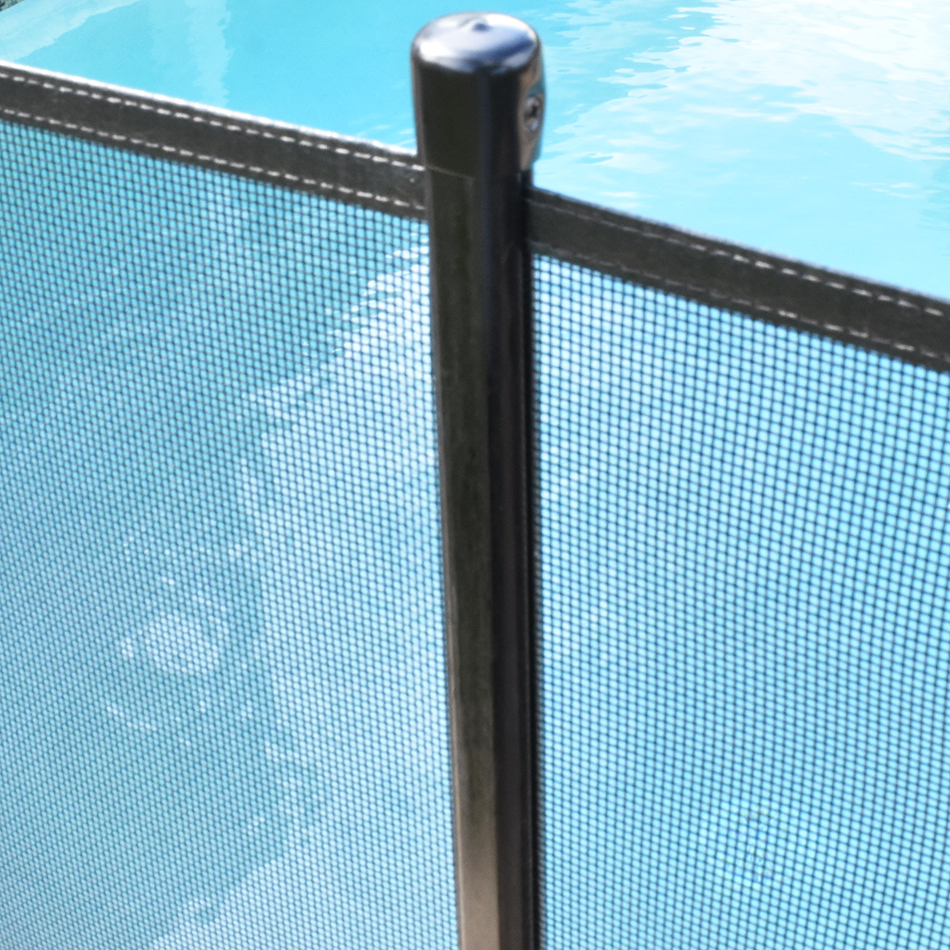
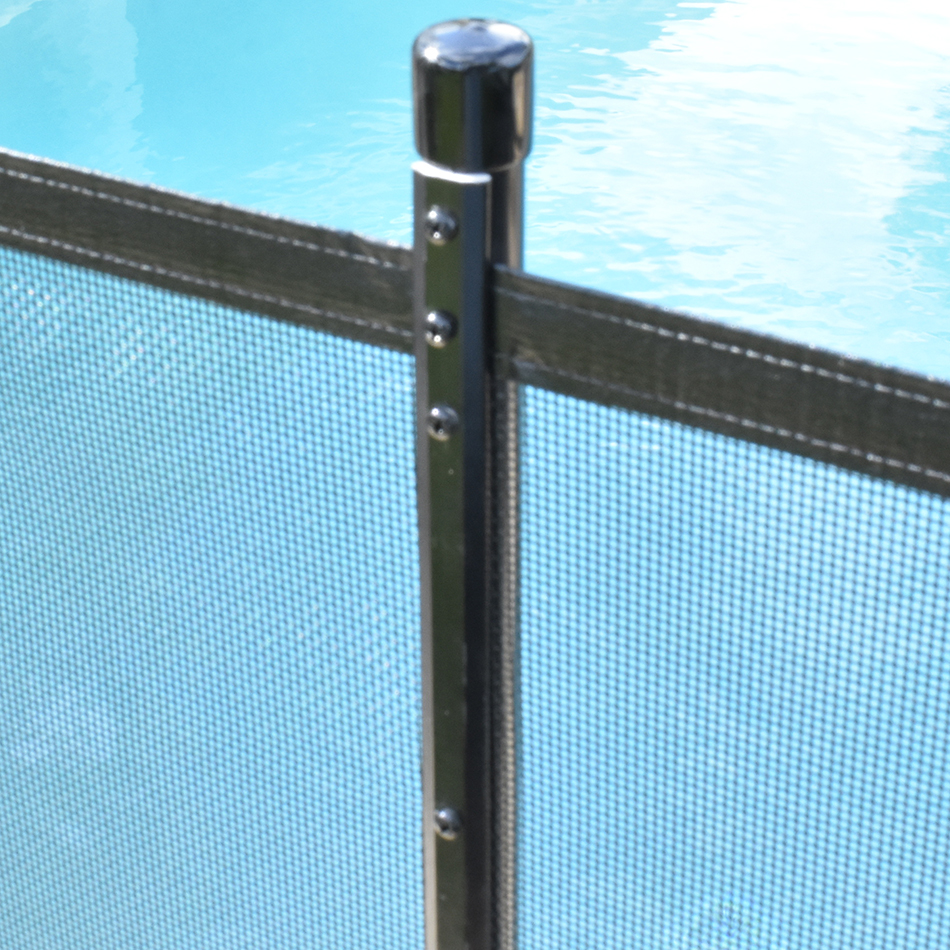
A significant difference between Protect-A-Child aluminum support posts and competing X or Y extrusion posts is our “double wall” reinforced post (see below). Basically a post inside a post. The additional reinforcement in these posts prevents breakage at the weakest point. It forces stress to travel well up the post prior to breakage occurring. This nearly doubles the strength of our aluminum support posts and provides you with a stronger, safer mesh pool fence.
|
Once again, knowing the facts will help you make the right decision.
|
3.
A COMPETITOR CLAIMS THEIR EXPERIENCE OFFERING FIBERGLASS POSTS IN THE
PAST SUPPORT THEIR OPINIONS.
Just as
it is true that there are strong and weak aluminum support posts on
the market, we have also seen cheap, weak, imitation fiberglass posts
introduced into the market in an attempt to compete with the overwhelming
success of Protect-A-Child’s quality Quad Bilt fiberglass support
posts. The fact that thin, weak, fiberglass posts broke or deteriorated
and provided them with their experience is no different than the reality
that thin walled, weak aluminum posts also break easily. Let’s
face it poor quality is poor quality. In our initial research and development
process with fiberglass support posts 12 years ago we tested numerous
fiberglass posts against the strongest aluminum posts on the market.
Prior to fielding any fiberglass post whatsoever, we used our experience
with posts of all types and their relative strength ratings to determine
minimal strength levels. We then made certain any composite fiberglass
posts incorporated into Protect-A-Child Pool Fences far exceeded the
strength of the less expensive aluminum post options. Only posts exceeding
our standards were chosen for introduction into our product line and
these posts have proven superior to aluminum posts in every category.
Sadly we continue to see posts on the market today (both fiberglass
and aluminum) that we feel are inadequate for mesh pool fence use.
When faced
with outlandish claims and blanket statements about post strength, we
suggest that you ask to see the test results that prove certain posts
to be superior or inferior. Comparative test results (comparing one
type of post with others under the same conditions) obtained under actual
use conditions* by an independent test lab will lead you to the
correct conclusion.
4.
A COMPETITOR CLAIMED THAT YOUR PATENTED LOCK- IN- DECK FEATURE
AND POINT LOCK LATCHES ARE JUST GIMMICKS.
Once
again, sales tactics seems to be that if your product offers no
advantages, you must try and discredit the advantages of others.
Our patented Lock
in Deck System and Point
Lock latches speak for themselves. They are clearly
superior to other available options. The Lock In Deck system is
the only system on the market where the fence posts actually twist
lock into the deck and are mechanically held in place preventing
removal.
Our Point
Lock Latches provide such a superior latching mechanism we are glad
that we don’t have to compete against them. Ask to see a demonstration
and you’ll be convinced.
5.
ONE SALESPERSON SAID YOU MUST SEW YOUR BORDER MATERIAL ONTO THE MESH
WITH 4 ROWS OF STITCHING AND INCORPORATE A REINFORCING LINE IN THE BORDER.
WHY DOES PROTECT-A-CHILD SEW YOUR BORDER ON WITH TWO ROWS OF STITCHING
AND DON'T USE REINFORCING LINE?
We have
been the leader in the mesh pool fence industry for over 20 years using
the same top quality UV resistant thread and sewing techniques in our
fences. In that time we have marveled at how many ways others attempt
to differentiate their fences to give their salespeople something to
talk about. Few of these differentiation techniques actually increase
the safety or quality of their fencing.
With respect
to sewing, border materials, and thread, we can't comment on the experience
of others with their sewing or thread or why they feel their borders
might require 4 rows of stitching. We draw upon 20 years experience
and the reality that we have experienced -0- failures of our thread,
borders or stitching process. It is simply unnecessary to apply additional
manufacturing steps to prevent problems that do not exist in our fences.
We offer a lifetime warranty against such
defects that back up our claim of manufacturing sufficiency.
Reinforcing
line in a mesh fence border was introduced into the market many
years ago by a company using a very weak mesh (one tenth the strength
of our Textilene). This mesh really needed some reinforcement.
The tactic was somewhat successful as this competitors salespeople
were able to focus customers more on the presence of the reinforcement
line and away from the reason the mesh might need it in the first
place. Again, our 20 years experience and the reality that in
that time there have been -0- failures of our mesh where any reinforcement
might have made any differences show such reinforcement to be
unnecessary. Our Textilene mesh far exceeds what is necessary
for sufficient strength and UV resistance in mesh pool fencing.
We welcome your calls and emails with any other questions. Contact Us
Warranty
»